
Hanfu (汉服, Hànfú) is the traditional clothing of the Han Chinese people, one of the world’s oldest continuous clothing traditions with a history spanning over 3,000 years. Characterized by its crossed collar, wide sleeves, and flowing robes tied with sashes, Hanfu is far more than historical costume—it is a living symbol of Chinese culture, philosophy, and aesthetics.
In this guide, we explore the origins, history, dynastic evolution, and classifications of Hanfu to help you understand why this ancient garment continues to captivate people worldwide.
Origins and History of Hanfu
The history of Hanfu begins long before the Han Dynasty itself. Its design reflects deep connections to Confucian rituals, Taoist harmony, and the agricultural rhythms of ancient China.
Pre-Han Dynasty Origins (Before 206 BCE)
The earliest forms of Hanfu trace back to the Shang Dynasty (c. 1600–1046 BCE) and Zhou Dynasty (1046–256 BCE). During this period, clothing was primarily made of hemp and silk, with the basic structure of yi (衣, upper garment) and shang (裳, lower skirt) already established.
The Zhou Dynasty formalized clothing into a strict ritual system. The Book of Rites (礼记) specified that garments should follow the shape of heaven (round sleeves) and earth (rectangular body), embedding cosmological beliefs directly into dress codes.
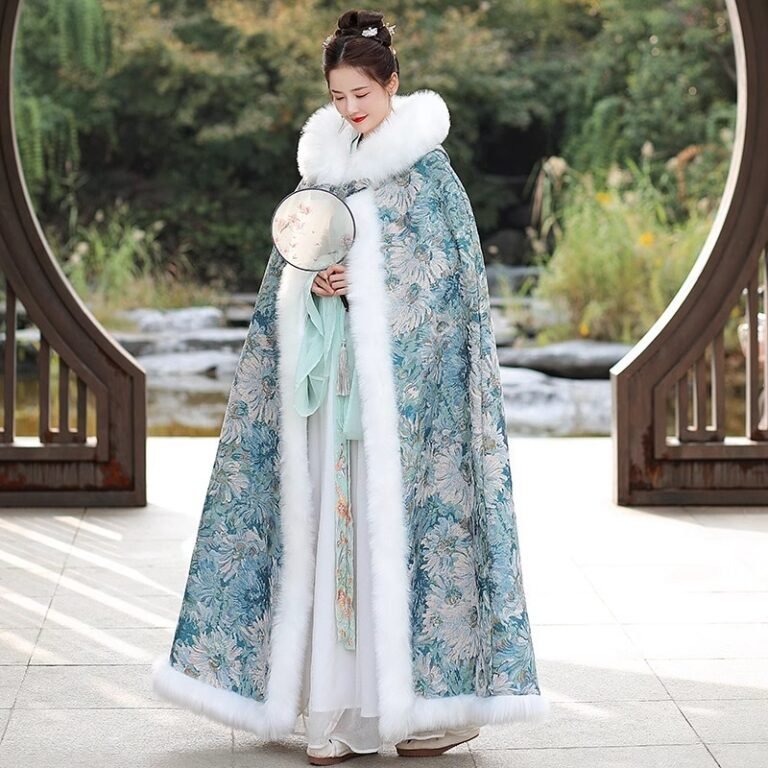
The Han Dynasty (206 BCE – 220 CE)
The Han Dynasty gave this clothing tradition its name—Hanfu literally means “Han clothing.” During this era, the iconic features solidified:
- Crossed collar (交领, jiāo lǐng): The right lapel overlaps the left, symbolizing the harmony of yin and yang.
- Wide sleeves: Representing generosity and cultural refinement.
- Sash ties: No buttons; garments were secured with woven sashes, emphasizing natural elegance.
The shenyi (深衣, deep robe) became the standard formal wear—a one-piece robe combining upper and lower sections, worn by scholars and officials.
The Tang Dynasty (618–907)
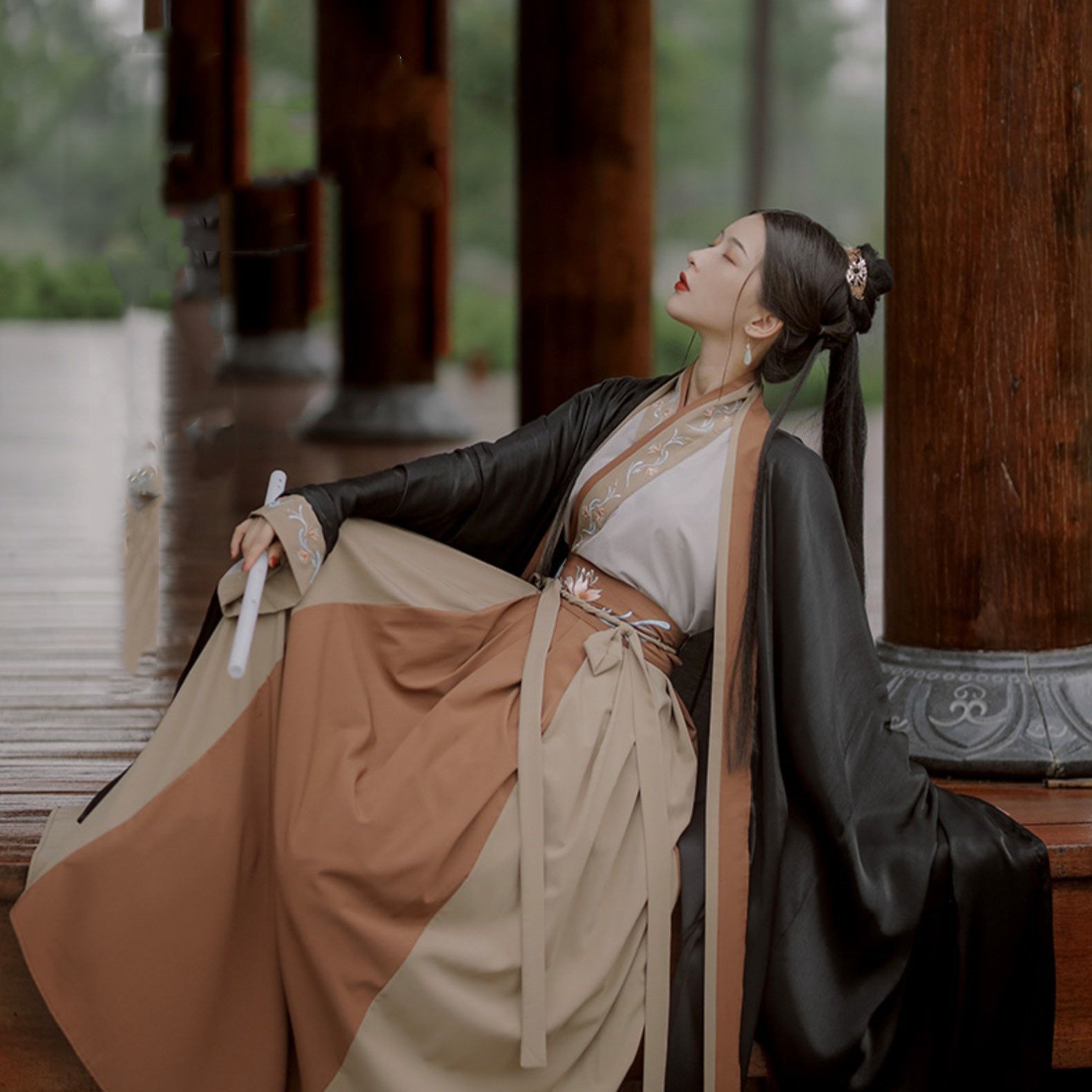
Often called the golden age of Hanfu, the Tang Dynasty introduced unprecedented diversity and color. As the capital Chang’an became a cosmopolitan hub along the Silk Road, Persian, Turkic, and Central Asian influences enriched Tang fashion.
Key developments included:
- Women’s fashion flourished: High-waisted ruqun (襦裙) with voluminous skirts became iconic. Necklines diversified into square, V-neck, and even off-shoulder styles.
- Bold colors and patterns: Gold-thread embroidery, floral motifs, and vibrant silks reflected Tang prosperity.
- Men’s round-collar robes: Influenced by nomadic cultures, the yuanlingpao (圆领袍) became popular for daily wear and official dress.
Tang Dynasty Hanfu remains the most visually recognizable style in modern revivals and media.
The Song Dynasty (960–1279)
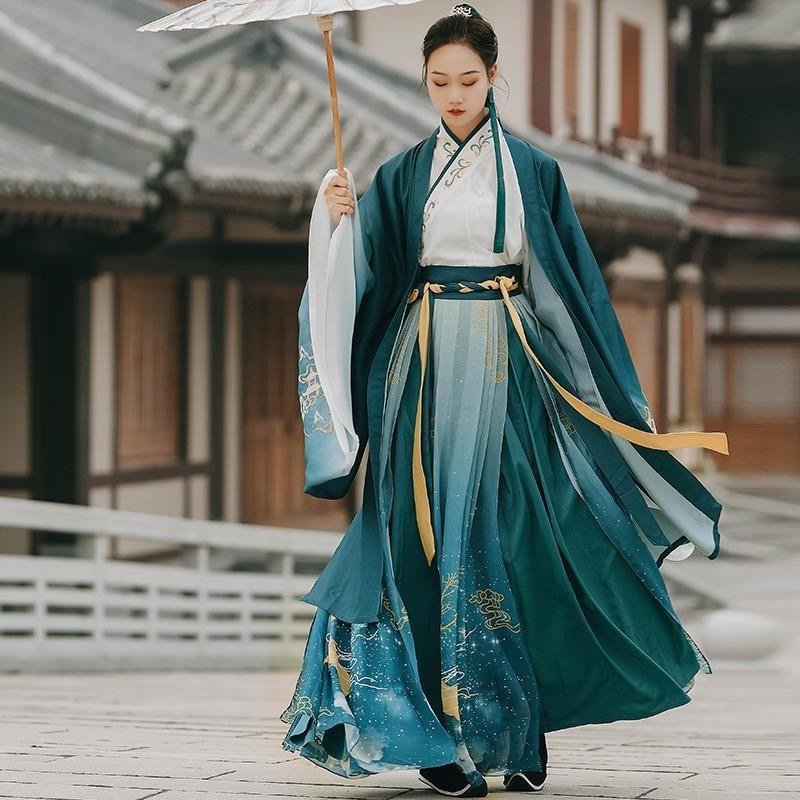
The Song Dynasty shifted toward understated elegance. Influenced by Neo-Confucianism and refined literati culture, Song Hanfu emphasized:
- Slimmer, more structured silhouettes
- Layered garments with subtle color gradations
- The beizi (褙子), a long, straight over-jacket worn by both men and women, which became a defining Song garment
Women’s songku (宋裤)—wide-legged trousers worn under skirts—offered practicality while maintaining graceful lines.
The Ming Dynasty (1368–1644)
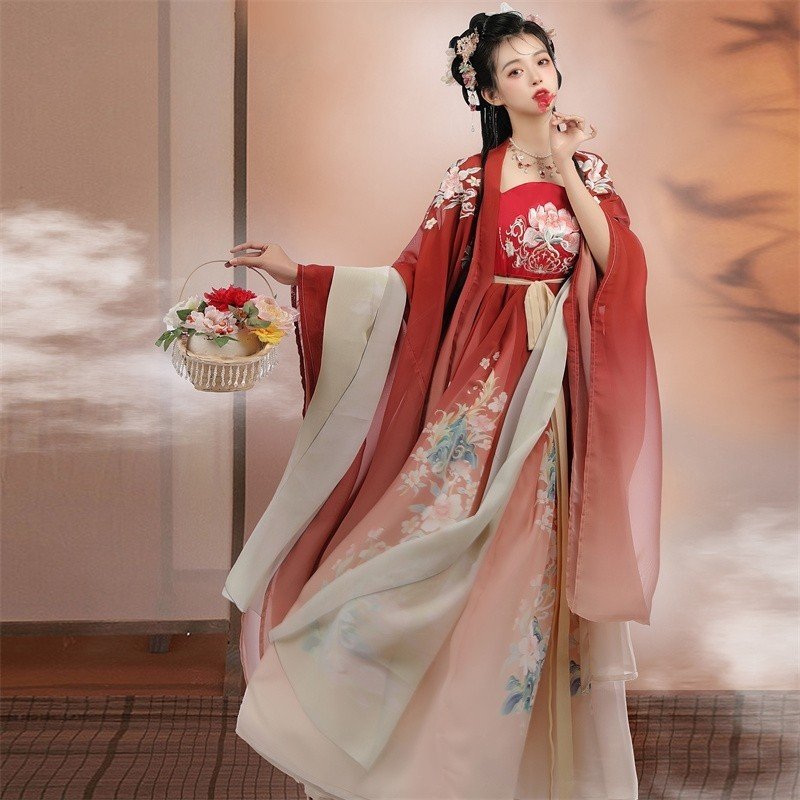
The Ming Dynasty represents the final flourishing of traditional Hanfu before the Manchu Qing Dynasty (1644–1912) imposed different clothing standards. Ming Hanfu is distinctive for:
- Restored Han traditions: After overthrowing the Mongol Yuan Dynasty, the Ming court deliberately revived pre-Yuan Han clothing norms.
- Stand-up collars (立领, lì lǐng): A Ming innovation that added structure and formality.
- The mamianqun (马面裙, horse-face skirt): A pleated wrap skirt with decorative panels at front and back, still widely worn today.
Ming-style Hanfu is particularly popular in contemporary Hanfu movements due to its well-documented patterns and dignified appearance.
Key Features of Hanfu
Despite evolving across dynasties, Hanfu maintains several universal characteristics:
| Feature | Description | Symbolism |
|---|---|---|
| Crossed collar | Right over left; never left over right (reserved for the deceased) | Yin-yang balance, respect for life |
| Wide sleeves | Flowing, loose arm openings | Elegance, scholarly refinement |
| Sash ties | No buttons; secured with woven belts | Natural simplicity, harmony |
| Flat cutting | Fabric cut in rectangles, draped on the body | Efficiency, minimal waste |
| Layering | Multiple garments worn together | Social hierarchy, seasonal adaptation |
Types and Classifications of Hanfu
By Garment Structure
1. Ruqun (襦裙)
The most common women’s style: a short jacket (ru) paired with a long skirt (qun). Variants include:
- Qixiong ruqun (齐胸襦裙): Skirt tied above the chest, iconic of Tang Dynasty fashion.
- Qiyao ruqun (齐腰襦裙): Skirt tied at the waist, popular across multiple dynasties.
2. Aoqun (袄裙)
A Ming Dynasty women’s style featuring a lined jacket (ao) over a mamianqun. It offers a more structured, modest silhouette compared to Tang ruqun.
3. Shenyi (深衣)
A one-piece robe connecting upper and lower sections. Worn by scholars and for ceremonial occasions, it embodies the Confucian ideal of covering the body completely as a sign of propriety.
4. Beizi (褙子)
A long, sleeveless or short-sleeved over-garment worn across Song, Yuan, and Ming periods. It functions as a light coat or decorative layer.
5. Yuanlingpao (圆领袍)
A round-collar robe originally for men, adapted from Central Asian styles during the Tang Dynasty. It became standard official wear.
By Occasion
| Occasion | Typical Style | Characteristics |
|---|---|---|
| Daily wear | Simple ruqun, short beizi | Lightweight fabrics, practical cuts |
| Formal/Ceremonial | Shenyi, elaborate aoqun | Rich embroidery, layered garments |
| Wedding | Red fengguan xiapei (phoenix crown and cape) | Intricate goldwork, auspicious symbols |
| Scholar/Official | * Lanshan*, *yuanlingpao* | Dark colors, rank badges |
Hanfu vs. Other Traditional Clothing
A common point of confusion: Hanfu is not the qipao (cheongsam). The qipao evolved from Manchu women’s dress during the Qing Dynasty and features a fitted silhouette, side slits, and frog buttons—elements foreign to Hanfu tradition.
Similarly, Hanfu differs from:
- Korean Hanbok: Though historically influenced by Ming Hanfu, the hanbok developed its own distinct high-waist and vibrant color blocking.
- Japanese Kimono: The kimono descends from Tang Dynasty Hanfu but evolved unique features like the obi sash and tsumugi weaving techniques.
Understanding these distinctions is essential for appreciating Hanfu as a specifically Han Chinese cultural heritage.
The Modern Hanfu Revival
Since the early 2000s, a grassroots Hanfu Movement (汉服运动) has emerged among young Chinese people. What began as online discussions has grown into a billion-yuan industry:
- Cultural identity: Wearing Hanfu reconnects younger generations with pre-Qing Han heritage.
- Social media influence: Platforms like Douyin (TikTok), Xiaohongshu, and Instagram have popularized Hanfu photography and styling.
- Global reach: Hanfu communities now exist across North America, Europe, and Southeast Asia.
Modern Hanfu designers blend historical accuracy with contemporary comfort, using breathable fabrics and simplified fastenings while preserving traditional aesthetics.
Frequently Asked Questions (FAQ)
What is the difference between Hanfu and qipao?
Hanfu is the traditional clothing of the Han Chinese with over 3,000 years of history, characterized by crossed collars and wide sleeves. The qipao (cheongsam) originated from Manchu dress in the Qing Dynasty and features a fitted body, high collar, and side slits.
When did Hanfu originate?
The earliest forms of Hanfu appeared during the Shang Dynasty (c. 1600 BCE), with the style formalized during the Zhou Dynasty and named during the Han Dynasty (206 BCE – 220 CE).
What are the main types of Hanfu?
The primary types include ruqun (jacket and skirt), aoqun (lined jacket and skirt), shenyi (one-piece robe), beizi (over-jacket), and yuanlingpao (round-collar robe). Each corresponds to different dynasties, genders, and occasions.
Is Hanfu still worn today?
Yes. While not everyday wear for most people, Hanfu enjoys a significant revival in China and globally. It is worn during traditional festivals (like Hanfu Day on the third day of the third lunar month), weddings, cultural events, and increasingly as fashion statements.
Which dynasty’s Hanfu is most popular now?
Ming and Tang Dynasty styles are currently the most popular. Ming Hanfu appeals for its structured elegance and well-preserved documentation, while Tang Hanfu is loved for its vibrant colors and romantic silhouette.
Conclusion
What is a Chinese Hanfu dress? It is a 3,000-year-old clothing tradition that embodies Chinese philosophy, aesthetics, and cultural identity. From the ritual garments of the Zhou Dynasty to the cosmopolitan silks of the Tang and the dignified robes of the Ming, Hanfu tells the story of Chinese civilization through fabric and form.
Whether you are a history enthusiast, a fashion lover, or someone exploring cultural heritage, understanding Hanfu offers a window into one of the world’s richest sartorial traditions—and its exciting modern renaissance.
Have questions about Hanfu styles, history, or how to wear them? Share your thoughts below.